go

History
Great designs come from great designers, not from great design processes.
Frederick P. Brooks, Jr.
The foundation for modern programming was laid at Bell Laboratories by Dennis Ritchie and Ken Thompson with the creation of the C programming language and the UNIX operating system.
The C programming language was essentially an abstract representation of hardware registers in variables, combinations of those variables in structures and the functions that could operate on them. The syntax was the minimal necessary. The language essentially supported structured systems programming.
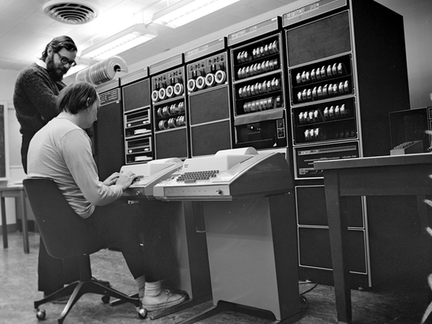
Photo: Dennis Ritchie (INTJ) and Ken Thompson (INTP) with the PDP-11 at Bell Laboratories (1972).
I had the privilege of visiting Bell Laboratories in Murray Hill, New Jersey > during my undergraduate years at Stevens Institute of Technology in Hoboken, New Jersey.
When the ideas of object oriented programming were desired by another Bell Laboratories research project undertaken by Bjarne Stroustrup (INTP), he introduced notions in Simula into what he called C with Classes. This project evolved into the C++ programming language.
C++ — however — never became feature-complete. Its standardization was delegated to a committee and they often took too long to agree on improvements. While there were a few significant conceptual leaps, the committee is stuck trying to introduce modern syntax from other languages into C++ with a new standard every 3 years. After more than three decades of language development, this is not a recipe for a stable and conceptually unified language.
Google founders Larry Page (INTP) and Sergey Brin (INTP) had used C++ in the early nineties to develop their search engine. This resulted in the most significant work at Google being done in C++. But for the reasons mentioned above, C++ became cumbersome to maintain. It was also difficult for even the experts to keep up with the volatility of the standard. Google decided to create a new language well suited for their backend processes.
They went back to Bell Laboratories legends Ken Thompson and Rob Pike for assistance. They added Robert Griesemer of HotJava fame into the team. They created the Go programming language. It was a minimalist design. They intentionally avoided the pitfalls of C++. The language was meant to be simple, yet sophisticated. They focused on the stability and the quality of the design. It was intended to make better use of modern multicore CPU architectures.
You can look at the Go programming language as the minimalist successor to the C programming language. Ken Thompson is the common link in these two endeavors. Now we have an elegant set of abstractions on top of what C used to provide. These include packaging and modularization complemented with design mechanisms for composition based integration.